
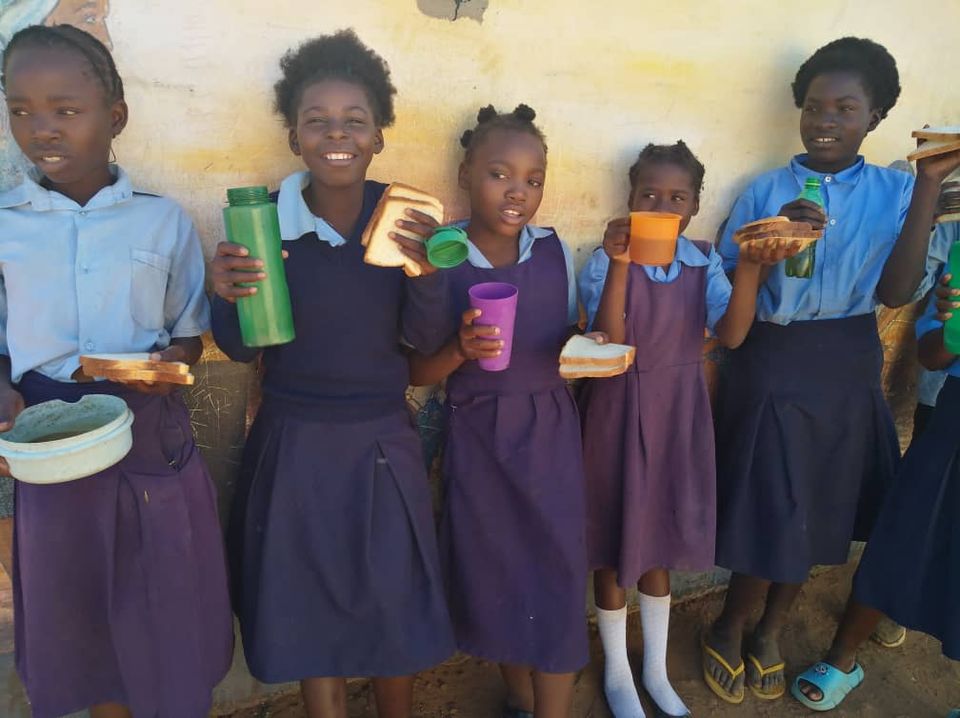
We’re publishing a chat/interview with Liam, who recently visited Zambia to see Kuseka’s projects!
Q. Liam, what did you see of the school lunch program at the school in Twabuka?
I had the opportunity to observe and help serve lunch (chicken and nshima, a traditional cornmeal dish) to the children, who waited their turn with great patience and in an orderly fashion. After the meal, each child washed their plate with water drawn from a well. The cooks do their best under difficult sanitary conditions, without the useful utensils typically found in school cafeterias.
Q. What was your impression of the teachers and the school principal?
They made a very good impression on me. They are available and well integrated into the community, and they carry out school programs tailored to the students’ level even in the absence of textbooks, teaching materials, and school supplies. The computers provided by the school are often out of order due to frequent power outages. The principal is a shrewd woman who knows how to navigate the system well and is particularly proud of the fact that the school in Twabuka is now attracting a growing number of students thanks to the direct and indirect benefits of the school cafeteria.
Q. Would you like to share a moment from your visit to the school?
The most moving moment of my visit to the school in Twabuka was the play put on by a small group of students with great artistic talent. They depicted typical family dynamics that lead young teenage girls to marry men who are often much older than they are in order to escape poverty and hardship. The ultimate goal of the performance was to raise awareness about the problems associated with early marriage.
D. Kuseka Zambia has supported—and continues to support—the Lushomo group home with targeted donations over the past few years. Can you briefly tell us about your visit to this small but precious place?
The Lushomo children’s home was designed to be an oasis of peace and serenity for about fifteen girls whose lives have been tragically marked by sexual violence inflicted primarily by close relatives or acquaintances. At this group home, victims of abuse receive both emotional and material support until they are able to start a new life—most often far from their communities of origin, since they have been rejected by their own families. The Lushomo group home is small, but truly invaluable to the young victims of hardships that are difficult to put into words.
D. Since 2012, Kuseka has been supporting—through small donations and constant communication—a small but incredibly strong woman, Claudia Lubinda, who, despite many physical challenges and financial hardships, including personal ones, dedicates herself every day to street children in one of Livingstone’s poorest neighborhoods. What did you find in her community?
Claudia cares for street children and other young people from particularly disadvantaged families in one of Livingstone’s poorest neighborhoods. Despite their obvious financial hardships, the children were full of enthusiasm for the activities Claudia organized—from reading to writing, from singing to dancing, and to playing. They spend time together and are so distracted by other worries—which are very burdensome for people their age. The service Claudia provided for them—and I found her to be an extraordinary person, all the more so because of her physical frailty—is commendable.
Q. What do you remember most about your time in Zambia?
I am left with memories of people who dedicated themselves to serving others, as well as of very poor children who, despite the real hardships of their lives, radiate a great zest for life. The country’s future lies in their hands—the support provided by Kuseka is crucial to their growth in the local context, and I hope it will continue for many years to come. Liam
__________________________________________
A huge thank you to Liam, with whom—after the COVID-19 pandemic—we’ve finally returned to in-person work in Zambia!